By the Quédate.ca team
The travel document, permanent resident card and risks to understand before leaving
After a positive refugee hearing decision or PRRA, many people want to travel again. They may wish to visit family in a third country, attend a wedding, take a holiday or respond to an emergency. Others may need to travel for work, study or medical treatment.
Being a protected person does not mean you can never leave Canada. It also does not mean you can use any passport, travel anywhere or return to Canada with only your positive decision letter.
Before buying a ticket, check three separate things: the document you will use to travel, whether your destination will admit you and what you need to return to Canada. Travel to the country where you said you faced risk, or seeking that country's consular protection, can have very serious immigration consequences.
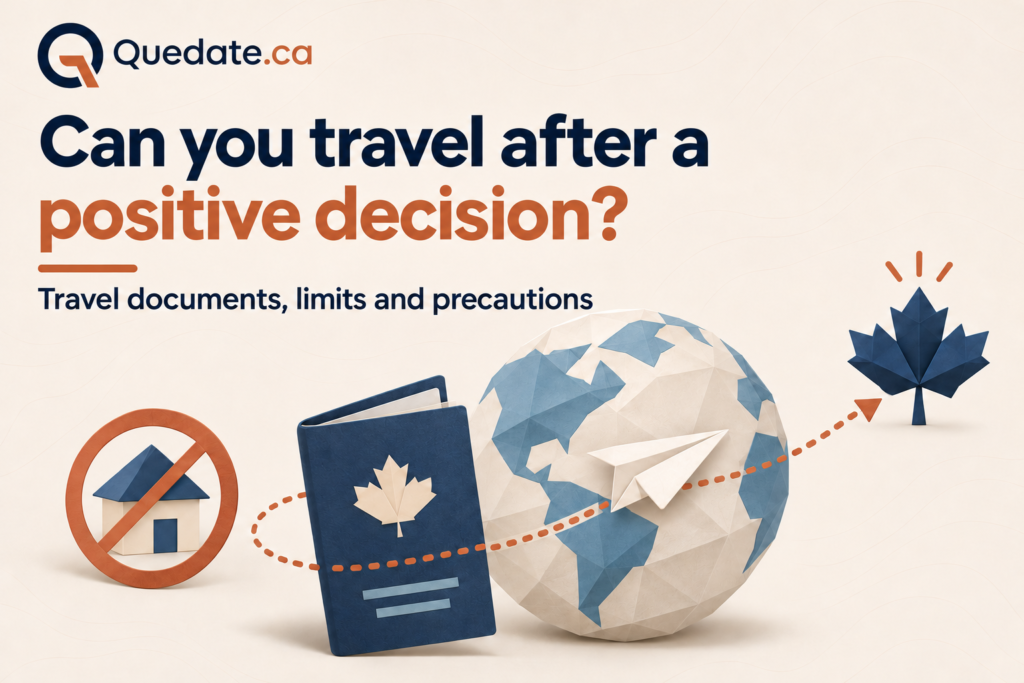
The Refugee Travel Document
People recognized in Canada as Convention refugees or persons in need of protection can apply for a Refugee Travel Document. It is issued by the Government of Canada. It is not a Canadian passport and does not make its holder a Canadian citizen. It allows a protected person to identify themselves and travel internationally without relying on the passport of the country from which they received protection.
The document has a blue cover with two diagonal black lines. It can be used for travel to various destinations, but is not valid for travel to its holder's country of citizenship.
You must apply while in Canada. Adults aged 16 or older currently use form PPTC 190; children under 16 use PPTC 192. Depending on the situation, proof of status may include a positive IRB decision letter, a Verification of Status following a positive PRRA, a Confirmation of Permanent Residence or a permanent resident card.
The application normally requires photographs, identity documents, proof of immigration status, payment of a fee and a guarantor who meets the requirements. Avoid buying non-refundable tickets before receiving the document. Applying does not guarantee it will be issued by your desired travel date.
A travel document does not guarantee entry to another country
Each country decides whether to accept a Refugee Travel Document and whether a visa is required. Even with a valid Canadian travel document, you may need a visa for Mexico, the United States, Colombia, a European country or another destination.
Check transit countries too. A stopover may require a transit visa even if you do not leave the airport. Before buying a ticket, contact the destination's embassy or consulate and ask specifically whether it accepts a Canadian Refugee Travel Document. Do not simply ask about a Canadian passport: they are different documents.
Check the airline's requirements as well. Someone else's experience with the same document does not guarantee that your requirements will be identical.
Travel to the country of persecution is different
A Refugee Travel Document cannot be used to travel to the country of citizenship or the country from which Canada granted protection. This relates to why protection was granted.
In a refugee claim, a person says they cannot return safely because they face persecution, torture, a risk to life or cruel and unusual treatment. If they voluntarily return after receiving protection, authorities may question whether the fear continues or whether the person has again accepted their country's protection.
A reason for travel can be understandable: illness, a funeral, seeing a child or a family emergency. An urgent or compassionate reason does not automatically remove immigration risk. The circumstances of the trip, its length, where the person stayed, contact with authorities, the passport used and reasons for returning may later be examined.
Do not buy a ticket to your country of origin assuming you can explain everything upon return. Obtain legal advice before travelling.
Be careful about applying for or using your national passport
Some people think there is no issue if they travel to a third country instead of the country of persecution. The document used also matters.
The Immigration and Refugee Board (IRB) explains that voluntarily applying for or renewing a passport from your country of nationality may create a presumption that you intended to seek that country's protection again. Using that passport to travel can increase the risk.
This does not mean protection is automatically lost whenever someone obtains or uses a national passport. In cessation proceedings, the circumstances are assessed, including whether the action was voluntary, whether the person intended to seek the country's protection again and whether that protection was actually obtained.
A person may have to explain why they sought a passport, why they did not use a Canadian travel document, where they travelled and what protection they received from their country's authorities. The issue may arise even when the passport was obtained before the refugee claim but used after protection was granted.
Not every contact with authorities has the same meaning. Requesting a civil registration, birth certificate or marriage document is not necessarily equivalent to seeking a passport. Each situation must be assessed separately. The prudent course is to obtain legal advice about possible consequences before applying for, renewing or using a national passport.
What is cessation of protection?
Cessation is a process in which the Minister asks the Refugee Protection Division (RPD) to determine that a person should no longer retain refugee protection. Grounds in the law include voluntarily reavailing oneself of the protection of the country of nationality, voluntarily reacquiring nationality, acquiring a new nationality that provides protection, or voluntarily re-establishing oneself in the country the person left.
Travel alone does not automatically produce a cessation decision. The Minister must make an application, and the RPD must consider the evidence and circumstances. The person affected has the right to respond and participate.
Consequences can nevertheless be serious. If the RPD determines that protection has ceased, the person may lose protected-person status. If they have already become a permanent resident, a final cessation decision based on certain grounds can also result in loss of permanent residence.
A permanent resident card does not remove this risk. Permanent residence and refugee protection are related but distinct statuses. Someone who becomes a permanent resident after receiving protection must still consider the consequences of returning to their country or using its passport.
What do you need to return to Canada?
The documents needed depend on your status at the time of travel. If you are still a protected person and not a permanent resident, check that your Refugee Travel Document is valid and that your documents permit your return. A valid Canadian travel document may be exempt from visa or eTA requirements, but confirm the conditions that apply before leaving.
If you are a permanent resident returning by plane, bus, train or boat, you normally need a valid Refugee Travel Document or other travel document and a valid permanent resident card. The PR card proves your status in Canada but is not a passport. The Refugee Travel Document allows travel but does not replace the PR card required for a permanent resident to board commercial transport to Canada.
If you are outside Canada without a valid PR card, you may need a Permanent Resident Travel Document (PRTD) to return by commercial transport. Do not confuse the two:
- Refugee Travel Document: allows international travel as a protected person.
- Permanent Resident Travel Document: allows a permanent resident abroad without a valid PR card to return by commercial transport.
Their names are similar, but their purposes differ.
Before buying a ticket
- Check that your Refugee Travel Document will be valid throughout the trip.
- Confirm that your destination accepts it and whether an entry or transit visa is needed.
- If you are a permanent resident, check that your PR card is valid.
- Confirm what you need to return to Canada.
- Consider whether the destination is connected to your country of citizenship or persecution.
- Consider whether you have applied for, renewed or used a national passport and whether the trip could raise questions about your need for protection.
If the trip involves your country of origin, country of persecution or use of its passport, do more than ask a travel agency. Consult an authorized professional who can review your refugee decision, current status and the trip's specific purpose.
Frequently asked questions
Can a protected person travel outside Canada?
Yes. They can apply for a Refugee Travel Document and travel to countries that accept it, provided they meet the destination's immigration requirements.
Can I use my national passport to travel to a third country?
It can create a risk of cessation because it might be interpreted as accepting the protection of the country of nationality again. Loss of status is not automatic, but obtain advice before using it.
Can I travel to my country for a family emergency?
The reason may matter, but an emergency does not automatically remove the risk. Travel to the country of persecution can lead to cessation proceedings. Obtain advice before travelling.
Does a permanent resident card work as a passport?
No. A PR card proves permanent resident status, but you also need a valid passport or travel document.
Can I lose my permanent resident status because of travel?
In certain circumstances, yes. A final cessation decision based on some grounds under the Immigration and Refugee Protection Act (IRPA) can also result in loss of permanent residence.
Does a Canadian travel document allow entry to any country?
Not automatically. Each country decides whether to accept it and require a visa. Check transit requirements as well.
Should I buy a ticket before applying for the document?
It is not recommended. The Government of Canada advises against finalizing travel plans until you receive the requested document.
Official sources consulted
- IRCC: documents needed to travel as a protected person
- Government of Canada: applying for a travel document
- IRCC: travel outside Canada as a permanent resident
- IRB: cessation of protection
- IRPA, section 108: cessation of protection
- IRPA, section 46: loss of permanent resident status
Important notice: This article was prepared by the Quédate.ca team for educational and informational purposes only. It is not legal advice, does not create a lawyer-client or consultant-client relationship and does not replace an individual assessment by an authorized legal representative. Canadian immigration and refugee laws, regulations, policies and procedures can change. Before acting or making a decision, check current law and official information applicable to your situation and, when appropriate, obtain authorized professional advice.
Know someone preparing for a refugee hearing? Share our educational course.
Explore the refugee hearing course