By the Quédate.ca team
How to declare your spouse, partner and children correctly, even if they are outside Canada
When someone receives a positive refugee hearing decision or a positive PRRA that grants protection, their family is often one of their first concerns.
Some people have their spouse and children with them in Canada. Others have been separated for months or years. Some situations are more complicated: children from previous relationships, partners who no longer live together, children in the other parent's custody or relatives whose current whereabouts are unknown.
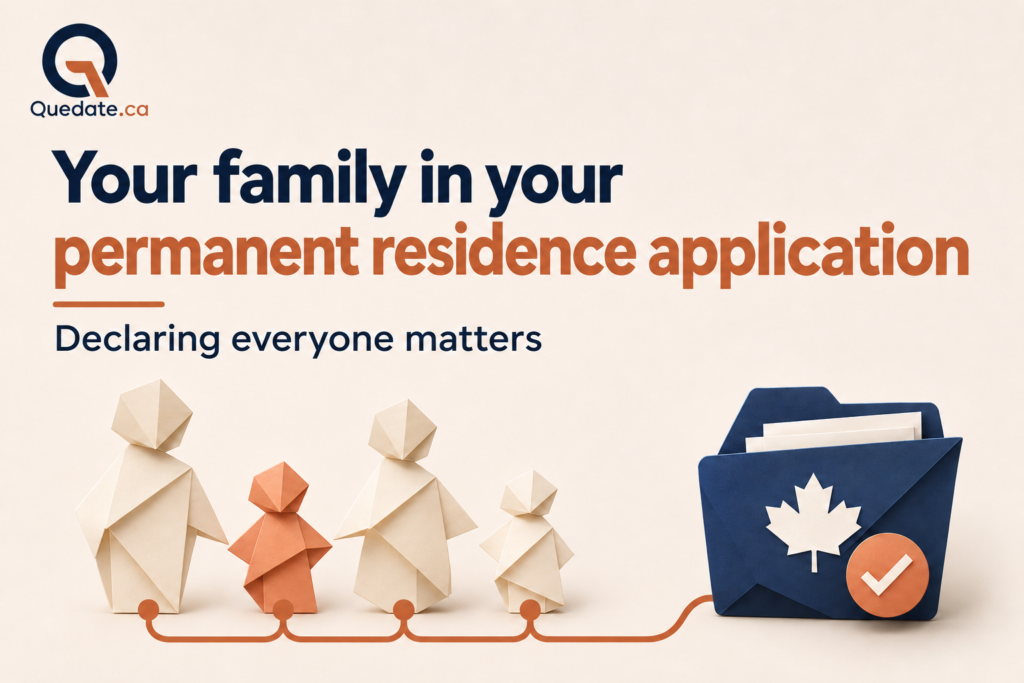
When applying for permanent residence as a protected person, listing only the people who will travel with you is not enough. You must declare all family members whom IRCC considers part of your family, even if they are not applying for permanent residence at that time. There is an important difference between declaring a family member and asking for that person to be processed for permanent residence.
Declaring a family member does not mean everyone must come now
IRCC requires you to disclose all your dependants. This includes family members living outside Canada, people who do not wish to travel at present and relatives with whom you do not have a close relationship. Once they are declared, you can indicate which ones you want processed for permanent residence with you.
For example, a protected person may have a daughter living abroad who does not want to travel immediately. Even if she will not be processed at that time, she must not be omitted. Her existence, details and family relationship must be correctly recorded.
The same may apply to a spouse from whom you are separated but not divorced. A separation does not allow you to say you are single or leave your spouse out of the forms. Describe each relationship as it actually exists.
A protected person may request processing for some family members and list others as non-accompanying. All must be declared, so IRCC can understand the family's actual composition and determine what documents, examinations or checks are needed.
Who can be included as a dependant?
Family members who can normally be processed as dependants in this category include a spouse, common-law partner, dependent children and the dependent children of those children.
A spouse is a person to whom you are legally married. A common-law partner is generally someone with whom you have lived in a conjugal relationship for at least 12 consecutive months. Dating, a long-distance relationship or separate periods of living together that do not meet the requirement are not enough.
Dependent children must normally be under 22 and have no spouse or common-law partner. Adopted children and your spouse's or partner's children may also be included if they meet the applicable definition.
In some circumstances, a child aged 22 or older can still qualify if they have depended financially on their parents since before turning 22 and cannot support themselves because of a physical or mental condition.
Parents, siblings, aunts, uncles and cousins cannot be included as dependants in this application. Their details may appear in family-information forms, but that does not mean they are applying for permanent residence with you.
A child's age may be locked in
Refugee and permanent residence processes can take years. An age lock-in rule allows a child's age to be fixed on a particular date. For most protected persons who claimed refugee protection in Canada, the child's age is locked in on the date IRCC or the Canada Border Services Agency (CBSA) received the complete refugee claim.
Imagine a child was 19 when their parent made the refugee claim. After the hearing and during permanent residence processing, the child turns 22 or 23. Passing the age limit does not necessarily exclude them because IRCC may use their age on the applicable date.
The rule locks in age, not every circumstance. The child must continue to have no spouse or common-law partner while the application is processed. Marriage or a common-law relationship can make the child ineligible as a dependant even if their age was locked in.
Do not look only at the child's current age. Identify when the refugee claim was made and check whether the other conditions continue to be met.
When family members are outside Canada
A protected person in Canada can apply for permanent residence and ask for a spouse, partner or dependent children abroad to be processed as part of the same application. This does not mean everyone will receive permanent residence at the same time.
IRCC may process the principal applicant in Canada first and transfer the family members' portion abroad. The responsible office may request forms, identity documents, proof of relationship, medical examinations, biometrics, police certificates or interviews.
Distance can create practical difficulties. It may be hard to obtain documents, see an authorized physician or reach a biometrics office. Some families do not communicate regularly or do not know where a relative currently lives. These difficulties are not a reason to conceal the person.
If you do not know their address, cannot contact them or believe an examination is impossible, declare the situation and explain it. IRCC will decide what instructions apply. Do not invent an address, say someone has died without being certain, or leave them out because you cannot locate them.
Family documents and examinations
IRCC may request evidence of a family member's identity and relationship to the principal applicant. Depending on the circumstances, this can include marriage or birth certificates, adoption records, custody decisions, identity documents or evidence of a common-law relationship.
For a common-law relationship, you normally need to show at least one year of continuous cohabitation. Leases, joint accounts, bills, bank records, correspondence and other evidence of shared life may help. If a document does not exist or cannot be obtained, explain why and provide any alternative evidence available.
Family members may also need medical examinations, security checks and background checks even if they will not travel to Canada immediately. IRCC will provide instructions. For most permanent residence applications outside Express Entry, an applicant normally waits for IRCC's instruction before taking a medical exam rather than arranging one on their own.
If a custody order exists or the other parent does not consent to a child's travel, the situation needs review before promising that the child can come to Canada. Being an immigration dependant does not replace custody rules or any required permission for a child to leave their country.
Omitting a family member can have serious consequences
Some people think they can leave a family member out and sponsor them after becoming permanent residents. That decision can close the door to future reunification.
Immigration rules generally prevent later sponsorship of a family member who was not declared and examined when required. A significant omission can also raise concerns about false or incomplete information and, depending on the circumstances, affect the application or even status already obtained.
For several years a temporary public policy allowed some people to sponsor certain previously undeclared family members. That policy ended on September 10, 2026. An application made now should not rely on a future exception to correct an omission.
Declare a child who lives with the other parent, a marriage that has not legally ended, a child with whom you have no contact and a partner who does not want to travel. Declaring someone does not guarantee approval, but concealing them can make later processing impossible.
Report changes during processing
Family circumstances can change while IRCC processes a permanent residence application. If you marry, enter a common-law relationship, have a child, divorce or a family member dies, notify IRCC before the application is finalized.
For example, someone who applied as single and later marries should not wait until receiving permanent residence to mention the marriage. The new spouse must be declared and the application updated. The same applies to a newborn, even if the baby does not yet have a passport or final registration. Inform IRCC, which will explain what documents to provide.
Waiting until after permanent residence to disclose a change can lead to consequences that are harder to correct.
A practical step
Before applying for permanent residence, map out your whole family: current and former marriages, common-law partners, biological and adopted children, children from previous relationships, and dependants inside or outside Canada.
Compare this information with your Basis of Claim (BOC), refugee forms, PRRA and earlier documents. If there is a difference, do not ignore it or silently change information. Determine why it occurred and seek guidance on how to explain it correctly. A family application should reflect the real and complete family, not just the people who are nearby.
Frequently asked questions
Can I include my spouse who lives outside Canada?
Yes. A protected person may ask for an eligible spouse or partner abroad to be processed in the permanent residence application, provided they meet the requirements and supply the requested documents.
Must I declare a child who will not travel with me?
Yes. Declare all children, including those living with the other parent, those who do not want to travel and those who will not be processed at that time.
What if my child turned 22 during the process?
They may remain a dependant if they were under 22 on the applicable date and continue to meet the other conditions. For many protected persons, age is fixed when the complete refugee claim was received.
Can my child marry while waiting?
Age may be locked in, but the child must continue to have no spouse or common-law partner. A change in marital status can make them ineligible as a dependant.
Can I include my parents or siblings?
Not as dependants in this application. Provide the information the forms request, but listing them as relatives does not grant them permanent residence.
What if I do not know where a family member is?
Declare the person and explain that you do not know their location or cannot contact them. Do not leave them out or invent information.
Can I later sponsor a family member I did not declare?
Generally, a family member who was not declared and examined when required may be excluded from later sponsorship. The temporary policy that permitted some exceptions ended on September 10, 2026.
Official sources consulted
- IRCC: applying for permanent residence as a protected person
- IRCC: who qualifies as a dependent child
- IRCC: medical exams for permanent residence applicants
- IRCC: end of the policy for undeclared family members
Important notice: This article was prepared by the Quédate.ca team for educational and informational purposes only. It is not legal advice, does not create a lawyer-client or consultant-client relationship and does not replace an individual assessment by an authorized legal representative. Canadian immigration and refugee laws, regulations, policies and procedures can change. Before acting or making a decision, check current law and official information applicable to your situation and, when appropriate, obtain authorized professional advice.
Know someone preparing for a refugee hearing? Share our educational course.
Explore the refugee hearing course