Por el Equipo de Quédate.ca
Cómo validar la solicitud, hablar con claridad y avisar cualquier problema
Si no hablas suficiente inglés o francés para participar en tu audiencia, puedes tener un intérprete. La Immigration and Refugee Board, conocida como IRB, proporciona este servicio sin costo.
El intérprete ayuda a que puedas entender y ser entendido. No es tu representante, no prepara tus respuestas y no decide tu caso. Por eso es importante saber qué hace, cómo hablar y cuándo avisar que existe un problema.
Valida que el intérprete haya sido solicitado
En el BOC puedes indicar el idioma que deseas usar en la audiencia y si necesitas intérprete. Revisa tu copia para validar que la solicitud se hizo y que el idioma y el dialecto son correctos.
No tienes que buscar ni llevar a un intérprete para la audiencia. La IRB asigna a esa persona. Si no lo solicitaste, si ahora lo necesitas o si el idioma o dialecto cambió, contacta a la RPD lo antes posible.
El formulario BOC indica que cualquier cambio en el idioma de la audiencia o en el idioma o dialecto de interpretación debe informarse por escrito al menos 10 días calendario antes de la audiencia.
Qué hace el intérprete
El intérprete es neutral. Su trabajo es transmitir con la mayor fidelidad posible lo que dicen el miembro, tú y las demás personas que participan.
El intérprete no debe:
- Explicarte qué respuesta conviene dar.
- Agregar información a tu historia.
- Hablar por ti.
- Darte asesoría legal.
- Decidir si tu respuesta es buena o mala.
Antes de comenzar deben comprobar que se entienden
El día de la audiencia, si usarás intérprete, hablarás con esa persona antes de que comience el testimonio. La RPD usa este momento para comprobar que pueden comunicarse y entenderse.
Escucha con atención. Si el acento, el dialecto, el volumen o alguna palabra te impiden entender, dilo en ese momento. No respondas que todo está bien si ya notas un problema.
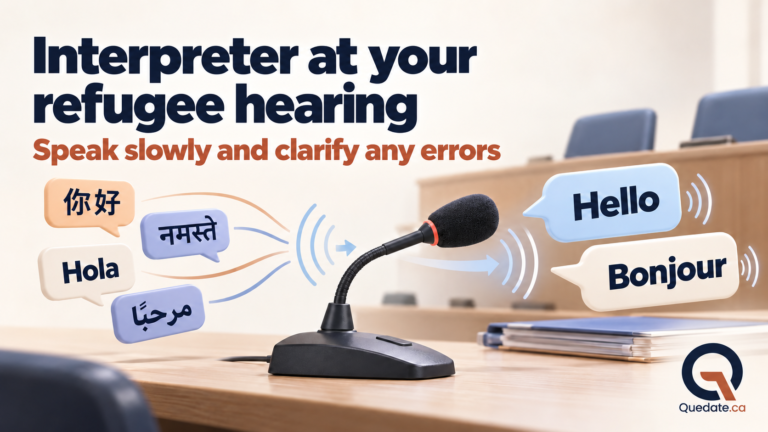
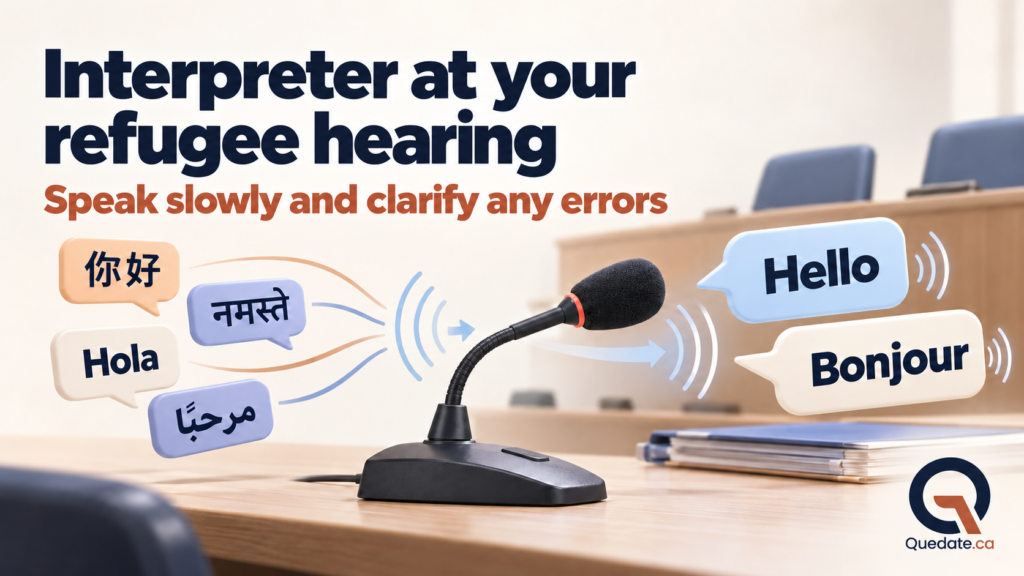
Habla despacio y por partes
Responde con frases cortas. Haz una pausa después de cada idea para que el intérprete pueda transmitirla completa. Si hablas durante mucho tiempo sin parar, puede ser más difícil conservar todos los detalles.
Usa palabras claras. Evita regionalismos cuando exista una palabra más sencilla. Una misma palabra puede tener otro significado en otro país.
Habla al miembro, no al intérprete. El intérprete facilita la comunicación, pero la conversación de la audiencia es entre tú y la persona que decide el caso.
Qué hacer si no entiendes
Detén la respuesta y avisa de inmediato. Puedes decir:
- No entendí la pregunta. ¿Puede repetirla, por favor?
- No entendí la interpretación. ¿Puede decirlo más despacio?
- ¿Puede dividir la pregunta en partes?
- Quiero confirmar que entendí bien. ¿Me está preguntando…?
Pedir que repitan una pregunta es mejor que responder algo que no entendiste.
Qué hacer si la interpretación cambia lo que dijiste
Si notas que faltó una parte o cambió el sentido, no esperes hasta el final. Dilo con respeto en ese momento.
Puedes decir: Eso no es lo que quise decir o Creo que la interpretación no refleja completa mi respuesta. Si tienes representante, también puedes avisarle para que plantee el problema ante el miembro.
La RPD indica que, si tienes dificultad para entender al intérprete en cualquier momento, debes informárselo al miembro.
No finjas que entendiste
Algunas personas sienten vergüenza o miedo de interrumpir. Pero seguir adelante sin entender puede producir una respuesta equivocada y crear una confusión que después será difícil aclarar.
Tampoco respondas basándote solamente en una palabra que reconociste. Espera la interpretación completa y asegúrate de entender la pregunta.
Cómo practicar antes
- Practica responder en frases cortas y hacer pausas.
- Identifica palabras locales que puedas explicar de forma sencilla.
- Ensaya las frases que usarás para pedir repetición o aclaración.
- Revisa nombres propios, lugares y siglas que puedan ser difíciles de pronunciar.
- Recuerda que practicar no significa memorizar respuestas.
Errores que debes evitar
- Buscar tu propio intérprete para reemplazar el que asigna la IRB sin seguir el proceso.
- Esperar hasta el día de la audiencia para avisar que el idioma o dialecto es incorrecto.
- Hablar demasiado rápido o en párrafos muy largos.
- Usar muchos regionalismos sin explicarlos.
- Mirar al intérprete esperando que te ayude a responder.
- Guardar silencio cuando sabes que la interpretación cambió tu respuesta.
Conclusión
El intérprete existe para que puedas participar de manera justa y comprender lo que ocurre. La mejor forma de usar este apoyo es validar el idioma solicitado, hablar con calma y avisar de inmediato cualquier dificultad.
Tu historia sigue siendo tuya. El intérprete transmite tus palabras; tú debes contar los hechos con honestidad y claridad.
Frequently asked questions
¿La IRB cobra por el intérprete?
No. La IRB proporciona gratuitamente un intérprete cuando la persona no habla suficiente inglés o francés para la audiencia.
¿Debo llevar a alguien para que traduzca?
No. La IRB asigna al intérprete. Tú debes validar que fue solicitado y que el idioma y dialecto son correctos.
¿Puedo decir que la interpretación no fue correcta?
Sí. Informa al miembro de inmediato y explica con respeto qué parte no reflejó lo que dijiste.
Consulta la información oficial
- IRB: Quiénes estarán en la audiencia e intérprete
- IRB: Paso 6, asistir a la audiencia
- IRB: Formulario Basis of Claim
- IRB: Directriz 7 sobre preparación y desarrollo de la audiencia
Da el siguiente paso en tu preparación
Conoce el sistema integral de preparación de quedate.ca para trabajar tu BOC, narrativa, pruebas, preguntas difíciles, intérprete, comunicación y participación en la audiencia.
Conoce el sistema integral de preparación
Aviso importante: Este artículo fue preparado por el Equipo de Quédate.ca con fines exclusivamente educativos e informativos. No constituye asesoría legal, no crea una relación abogado-cliente o consultor-cliente y no sustituye el análisis individual de un representante legal autorizado. Las leyes, reglamentos, políticas y procedimientos de inmigración y refugio en Canadá pueden cambiar. Antes de actuar o tomar una decisión, verifica la legislación vigente y la información oficial aplicable a tu situación y, cuando corresponda, obtén asesoría profesional autorizada.
By the Quedate.ca Team
How to check the request, speak clearly and report any problem
If you do not speak enough English or French to participate in your hearing, you can have an interpreter. The Immigration and Refugee Board, known as the IRB, provides this service free of charge.
The interpreter helps you understand and be understood. They are not your representative, do not prepare your answers and do not decide your case. That is why it helps to know what they do, how to speak and when to report a problem.
Check that an interpreter has been requested
On your BOC, you can indicate which language you want to use at the hearing and whether you need an interpreter. Review your copy to check that the request was made and that the language and dialect are correct.
You do not need to find or bring an interpreter to the hearing. The IRB assigns that person. If you did not request one, now need one, or the language or dialect has changed, contact the RPD as soon as possible.
The BOC form states that any change to the language of the hearing or the language or dialect of interpretation must be reported in writing at least 10 calendar days before the hearing.
What the interpreter does
The interpreter is neutral. Their job is to convey what the member, you and the other participants say as faithfully as possible.
The interpreter must not:
- Explain which answer you should give.
- Add information to your story.
- Speak on your behalf.
- Give you legal advice.
- Decide whether your answer is good or bad.
Before the hearing begins, they must check that you understand each other
On the hearing day, if you are using an interpreter, you will speak with that person before testimony begins. The RPD uses this time to check that you can communicate and understand each other.
Listen carefully. If the accent, dialect, volume or a word prevents you from understanding, say so at that point. Do not say that everything is fine if you already notice a problem.
Speak slowly and in short sections
Answer in short sentences. Pause after each idea so that the interpreter can convey it fully. If you speak for a long time without stopping, it may be harder to retain all the details.
Use clear words. Avoid regional expressions when there is a simpler word. The same word may mean something different in another country.
Speak to the member, not the interpreter. The interpreter helps you communicate, but the hearing conversation is between you and the person deciding your case.
What to do if you do not understand
Stop answering and say so immediately. You can say:
- I did not understand the question. Could you repeat it, please?
- I did not understand the interpretation. Could you say it more slowly?
- Could you break the question into parts?
- I want to make sure I understood correctly. Are you asking me…?
Asking for a question to be repeated is better than answering something you did not understand.
What to do if the interpretation changes what you said
If you notice that something was left out or the meaning changed, do not wait until the end. Say so respectfully at that moment.
You can say: That is not what I meant, or I think the interpretation does not fully reflect my answer. If you have a representative, you can also tell them so they can raise the problem with the member.
The RPD says that if you have difficulty understanding the interpreter at any point, you must tell the member.
Do not pretend you understood
Some people feel embarrassed or afraid to interrupt. But continuing without understanding may lead to a wrong answer and create confusion that is difficult to clear up later.
Do not answer based only on one word you recognized, either. Wait for the full interpretation and make sure you understand the question.
How to practise beforehand
- Practise answering in short sentences and pausing.
- Identify local words that you can explain simply.
- Rehearse the phrases you will use to ask for repetition or clarification.
- Review names, places and acronyms that may be difficult to pronounce.
- Remember that practising does not mean memorizing answers.
Mistakes to avoid
- Finding your own interpreter to replace the one assigned by the IRB without following the process.
- Waiting until the hearing day to report that the language or dialect is incorrect.
- Speaking too quickly or in very long paragraphs.
- Using many regional expressions without explaining them.
- Looking at the interpreter expecting them to help you answer.
- Staying silent when you know the interpretation changed your answer.
Conclusion
The interpreter is there so that you can participate fairly and understand what is happening. The best way to use this support is to check the language requested, speak calmly and report any difficulty immediately.
Your story is still yours. The interpreter conveys your words; you must describe the facts honestly and clearly.
Frequently asked questions
Does the IRB charge for the interpreter?
No. The IRB provides an interpreter free of charge when a person does not speak enough English or French for the hearing.
Should I bring someone to interpret?
No. The IRB assigns the interpreter. You must check that one was requested and that the language and dialect are correct.
Can I say that the interpretation was incorrect?
Yes. Tell the member immediately and explain respectfully which part did not reflect what you said.
Consult the official information
- IRB: Who will be at your hearing, including the interpreter
- IRB: Step 6, go to your hearing
- IRB: Basis of Claim form
- IRB: Guideline 7 on preparing for and conducting a hearing
Take the next step in your preparation
Explore Quedate.ca’s complete preparation system to work on your BOC, narrative, evidence, difficult questions, working with an interpreter, communication and participation in the hearing.
Explore the complete preparation system
Important notice: This article was prepared by the Quedate.ca Team for educational and informational purposes only. It does not constitute legal advice, create a lawyer-client or consultant-client relationship, or replace an individual assessment by an authorized legal representative. Canada’s immigration and refugee laws, regulations, policies and procedures may change. Before taking action or making a decision, check the current legislation and official information that apply to your situation and, where appropriate, obtain authorized professional advice.