Por el Equipo de Quédate.ca
Cómo reconocer diferencias importantes y revisarlas antes de la audiencia
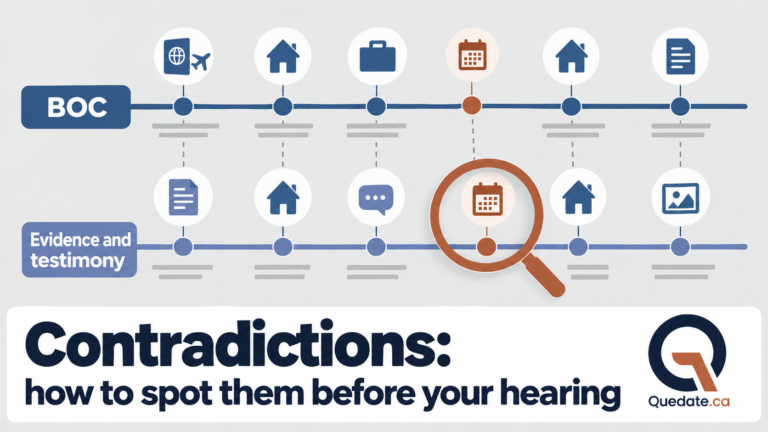
En un caso de refugio, la RPD puede comparar lo que escribiste en el BOC, lo que dijiste a las autoridades, tus otros formularios, tus pruebas, lo que dicen tus testigos y lo que explicas en la audiencia.
Si dos partes importantes no coinciden, pueden surgir preguntas sobre tu credibilidad. Pero una diferencia no significa automáticamente que una persona esté mintiendo. La propia guía jurídica de la IRB explica que las contradicciones deben ser reales, importantes y relacionadas con temas relevantes del caso para sostener una conclusión negativa seria.
Qué es una contradicción
Una contradicción aparece cuando dos afirmaciones no pueden ser verdaderas al mismo tiempo. Por ejemplo, el BOC dice que una amenaza ocurrió en mayo, pero un documento presentado como prueba dice que ocurrió en agosto del mismo año.
También puede haber una inconsistencia, cuando un dato cambia de una versión a otra, o una omisión, cuando un hecho importante aparece después pero no fue mencionado antes.
Estas palabras se parecen, pero no siempre tienen el mismo peso. El miembro debe mirar el contexto, la importancia del dato, las explicaciones y el resto de la evidencia.
Dónde pueden aparecer las diferencias
- Entre el BOC y la narrativa.
- Entre una entrevista de entrada y lo que dices en la audiencia.
- Entre formularios migratorios presentados en momentos diferentes.
- Entre tu historia y una denuncia, un reporte médico o un mensaje.
- Entre tu declaración y la de un familiar o testigo.
- Entre fechas, lugares, nombres, rutas de viaje o razones de una demora.
- Entre lo que dijiste antes y una publicación en redes sociales.
No toda diferencia destruye la credibilidad
La guía jurídica de la IRB señala que las decisiones de credibilidad no deben convertirse en una prueba de memoria ni basarse en una búsqueda exagerada de detalles pequeños. Las diferencias menores o secundarias no deberían, por sí solas, destruir toda la credibilidad cuando el resto de la evidencia apoya la historia.
También pueden existir razones reales para una diferencia: trauma, nervios, paso del tiempo, problemas de memoria, mala interpretación, dificultad para comprender una pregunta o un error al completar un formulario.
Eso no significa que toda explicación será aceptada. Significa que el miembro debe evaluar la diferencia dentro de todo el caso y considerar las explicaciones que correspondan.
Cuándo puede ser más seria
Una diferencia puede tener más peso cuando se relaciona con el centro del caso: quién causó el daño, qué ocurrió, por qué ocurrió, cuándo aumentó el peligro, si pediste protección, por qué no podías vivir en otra parte del país o qué riesgo existe si regresas.
Varias diferencias sobre puntos importantes también pueden acumularse. Por eso es mejor detectar los problemas antes de la audiencia y no encontrarlos por primera vez mientras respondes preguntas.
Cómo revisar tu expediente paso a paso
1. Reúne las versiones. Ten a mano el BOC, la narrativa, las notas o registros de entrevistas que poseas, los formularios migratorios, las pruebas y las declaraciones de testigos.
2. Haz una línea de tiempo. Escribe los hechos principales en orden. Incluye fechas exactas cuando las conozcas y marca claramente las que son aproximadas.
3. Compara nombres, lugares y fechas. Busca datos distintos y anota dónde aparece cada versión.
4. Revisa qué documento se creó primero. Un error de digitación no se analiza igual que una versión nueva sobre un hecho central.
5. Escribe la explicación verdadera. No prepares una excusa. Anota qué ocurrió y por qué existe la diferencia, si lo sabes.
6. Revisa el punto con la persona autorizada que te asesora. Esa persona puede ayudarte a entender si corresponde aclarar, corregir o presentar información adicional siguiendo las reglas.
Qué no debes hacer
- Cambiar una fecha para que todos los documentos parezcan iguales.
- Inventar una explicación que no ocurrió.
- Borrar mensajes, editar capturas o alterar documentos.
- Memorizar una versión sin entenderla.
- Esperar hasta la audiencia para contar por primera vez un error importante que ya conocías.
- Enviar cambios sin revisar las reglas ni hablar con tu representante, si tienes uno.
Si descubres un error en el BOC
La RPD permite enviar cambios o adiciones al BOC siguiendo un procedimiento. La información oficial indica que deben enviarse lo antes posible y que, en general, la RPD debe recibirlos al menos 10 días calendario antes de la audiencia.
Corregir un error no significa cambiar la historia para que suene mejor. Debes identificar claramente el cambio, decir la verdad y revisar las consecuencias con tu representante autorizado. Un cambio importante puede generar preguntas y debe poder explicarse.
Conclusión
La coherencia importa, pero una persona no es una máquina. Puede confundir una fecha, olvidar un detalle o haber entendido mal una pregunta.
La preparación responsable consiste en revisar el expediente completo, encontrar las diferencias, comprender por qué existen y tratarlas con honestidad. Si cuentas con una persona autorizada que te asesora, revisa siempre estos puntos con ella antes de actuar.
Frequently asked questions
¿Una contradicción pequeña significa que perderé mi caso?
No existe una respuesta automática. La RPD analiza la importancia de la diferencia, su relación con el caso, la explicación y toda la evidencia.
¿Puedo corregir mi BOC?
Sí puede ser posible siguiendo el procedimiento de la RPD. Hazlo sin demora y revisa el cambio con tu representante autorizado si tienes uno.
¿Qué pasa si no recuerdo una fecha exacta?
No inventes. Explica que es aproximada y señala lo que sí recuerdas con seguridad.
Consulta la información oficial
- IRB: Evaluación de credibilidad en solicitudes de refugio
- IRB: Preguntas y respuestas sobre cambios al BOC
- IRB: Directriz 7 sobre preparación y desarrollo de la audiencia
Da el siguiente paso en tu preparación
Conoce el sistema integral de preparación de quedate.ca para trabajar tu BOC, narrativa, pruebas, preguntas difíciles, intérprete, comunicación y participación en la audiencia.
Conoce el sistema integral de preparación
Aviso importante: Este artículo fue preparado por el Equipo de Quédate.ca con fines exclusivamente educativos e informativos. No constituye asesoría legal, no crea una relación abogado-cliente o consultor-cliente y no sustituye el análisis individual de un representante legal autorizado. Las leyes, reglamentos, políticas y procedimientos de inmigración y refugio en Canadá pueden cambiar. Antes de actuar o tomar una decisión, verifica la legislación vigente y la información oficial aplicable a tu situación y, cuando corresponda, obtén asesoría profesional autorizada.
By the Quedate.ca Team
How to recognize important differences and review them before the hearing
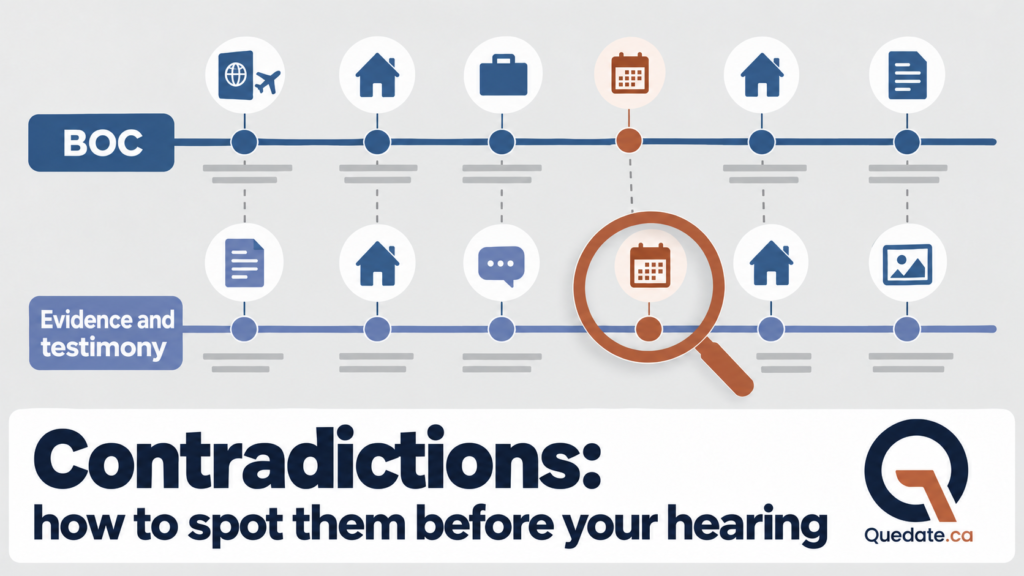
In a refugee claim, the RPD may compare what you wrote in your Basis of Claim (BOC) form, what you told the authorities, your other forms, your evidence, what your witnesses say, and what you explain at the hearing.
If two important parts do not match, questions may arise about your credibility. But a difference does not automatically mean that someone is lying. The IRB’s own legal guide explains that contradictions must be real, important, and related to relevant issues in the case to support a serious adverse finding.
What is a contradiction?
A contradiction arises when two statements cannot both be true. For example, the BOC says that a threat occurred in May, but a document submitted as evidence says it occurred in August of the same year.
There may also be an inconsistency, when a detail changes from one account to another, or an omission, when an important event is mentioned later but was not mentioned before.
These terms are similar, but they do not always carry the same weight. The member must consider the context, the importance of the detail, the explanations, and the rest of the evidence.
Where differences may appear
- Between the BOC and the narrative.
- Between an interview on entry and what you say at the hearing.
- Between immigration forms submitted at different times.
- Between your story and a complaint, a medical report, or a message.
- Between your statement and that of a family member or witness.
- Between dates, places, names, travel routes, or reasons for a delay.
- Between what you said before and a social media post.
Not every difference undermines credibility
The IRB’s legal guide states that credibility assessments should not become a memory test or rely on an excessive search for small details. Minor or peripheral differences should not, on their own, undermine overall credibility when the rest of the evidence supports the story.
There may also be genuine reasons for a difference: trauma, nervousness, the passage of time, memory problems, poor interpretation, difficulty understanding a question, or an error when completing a form.
This does not mean that every explanation will be accepted. It means that the member must assess the difference in the context of the whole case and consider the relevant explanations.
When a difference may be more serious
A difference may carry more weight when it relates to the heart of the case: who caused the harm, what happened, why it happened, when the danger increased, whether you sought protection, why you could not live in another part of the country, or what risk you face if you return.
Several differences on important points can also add up. That is why it is better to identify problems before the hearing rather than encounter them for the first time while answering questions.
How to review your case file step by step
1. Gather the different accounts. Have your BOC, narrative, any interview notes or records you have, immigration forms, evidence, and witness statements ready.
2. Make a timeline. Write the main events in order. Include exact dates when you know them and clearly mark those that are approximate.
3. Compare names, places, and dates. Look for different details and note where each version appears.
4. Check which document was created first. A typing error is not assessed in the same way as a new account of a central event.
5. Write down the true explanation. Do not prepare an excuse. Note what happened and why the difference exists, if you know.
6. Review the issue with the authorized professional advising you. That person can help you understand whether to clarify, correct, or submit additional information in accordance with the rules.
What you should not do
- Change a date to make all the documents appear consistent.
- Invent an explanation that did not happen.
- Delete messages, edit screenshots, or alter documents.
- Memorize an account without understanding it.
- Wait until the hearing to disclose an important error you already knew about.
- Submit changes without checking the rules or speaking with your representative, if you have one.
If you discover an error in your BOC
The RPD allows changes or additions to the BOC through a specific procedure. The official information states that they must be submitted as soon as possible and that, in general, the RPD must receive them at least 10 calendar days before the hearing.
Correcting an error does not mean changing your story to make it sound better. You must clearly identify the change, tell the truth, and review the implications with your authorized representative. A significant change may raise questions and must be explainable.
Conclusion
Consistency matters, but people are not machines. Someone may confuse a date, forget a detail, or have misunderstood a question.
Responsible preparation means reviewing the whole case file, finding the differences, understanding why they exist, and addressing them honestly. If an authorized professional is advising you, always review these points with them before acting.
Frequently asked questions
Does a small contradiction mean I will lose my case?
There is no automatic answer. The RPD considers the importance of the difference, its connection to the case, the explanation, and all the evidence.
Can I correct my BOC?
It may be possible by following the RPD’s procedure. Act without delay and review the change with your authorized representative if you have one.
What if I do not remember an exact date?
Do not make one up. Explain that it is approximate and state what you do remember with certainty.
Consult the official information
- IRB: Assessment of credibility in refugee claims
- IRB: Questions and answers about changes to the BOC
- IRB: Guideline 7 on preparing for and conducting a hearing
Take the next step in your preparation
Explore Quedate.ca’s complete preparation system to work on your BOC, narrative, evidence, difficult questions, working with an interpreter, communication and participation in the hearing.
Explore the complete preparation system
Important notice: This article was prepared by the Quedate.ca Team for educational and informational purposes only. It does not constitute legal advice, create a lawyer-client or consultant-client relationship, or replace an individual assessment by an authorized legal representative. Canada’s immigration and refugee laws, regulations, policies and procedures may change. Before taking action or making a decision, check the current legislation and official information that apply to your situation and, where appropriate, obtain authorized professional advice.